Decoding AI Models: My Journey from Jargon to Clarity
The other evening, I was casually browsing OpenRouter, a platform that lets you explore and compare different AI models. I wasn’t looking for anything in particular, just curious about how the newer models stacked up against the usual suspects like GPT-4 or Claude.
And then, I stumbled upon this summary 👇

At first glance, it looked impressive — big numbers, fancy names, and technical terms. But let’s be honest: unless you live and breathe AI research, it reads like another alphabet soup.
So, I decided to slow down. What do these words actually mean? And why should they matter to us — whether we’re building, leading, or just trying to understand the AI shift?
Context Length: The Model’s Memory
One of the first things that stood out was context length. In simple terms, it’s how much text a model can “see” at once.
- A smaller model might only remember a few pages of conversation.
- The bigger ones, like Grok 4 Fast, can handle 2 million tokens — that’s like feeding an entire bookshelf of books and still getting a coherent answer back.
Think of it as working memory for AI. Short memory means fragmented thoughts. Long memory means deep analysis across huge documents, codebases, or conversations.
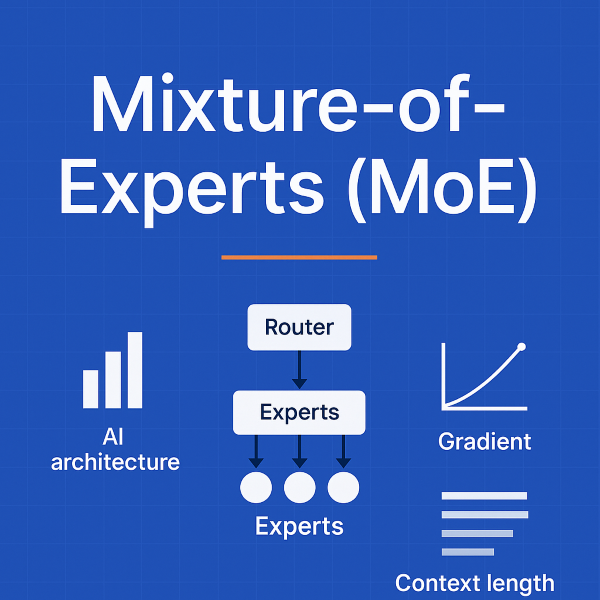
Mixture-of-Experts (MoE): Not Every Brain Cell at Once
Then came the phrase: “1T parameters with 32B active per forward pass.”
Here’s the trick: not all of those trillion parameters are working every time. That’s the beauty of Mixture-of-Experts (MoE).
Instead of a model where every neuron fires for every input (dense models), MoE routes your query to just a few specialized experts:
- Ask for math? It finds the math expert.
- Need code? It calls in the coding expert.
- Want natural language? Another expert takes over.
This way, the model has massive capacity but only spends energy where it matters.
Gradients & Routing: The Hidden Plumbing
As I dug deeper, I realized training these models is not just about scale — it’s about stability.
- Gradient: Think of it as the GPS signal that tells the model how to improve. Too weak, and the model doesn’t learn. Too strong, and it crashes.
- Routing: Imagine an air traffic controller deciding which “expert runway” each input should land on. Balanced routing means experts stay healthy; unbalanced routing means some get lazy, others burn out.
This is why new optimizers like MuonClip exist — they keep trillion-parameter models from collapsing under their own weight.
Quantization: The Art of Compression
Another technical term: fp8 quantization.
Instead of using heavy 32-bit numbers for everything, models store weights in 8-bit floating-point format. Think of it as compressing photos on your phone — smaller size, faster load, almost no visible difference. For trillion-parameter models, this is the difference between “runs in theory” and “runs in reality.”
The Business Side: Pricing in Tokens
Finally, the pricing model clicked.
Most APIs don’t charge for time — they charge by tokens. And they split it into two sides:
- Input tokens (your prompt).
- Output tokens (the model’s reply).
For example, Kimi K2 costs $0.38 per million input tokens and $1.52 per million output tokens. So, pasting in a 500-page PDF and getting back a 2,000-word summary might cost just a few cents.
The Takeaway
As I pieced it all together, one thing became clear:
These models aren’t just growing bigger. They’re growing smarter.
- MoE gives us scale without waste.
- Gradients and routing keep the training balanced.
- Quantization makes it practical.
- Context length opens up whole new use cases.
The hype isn’t in the jargon. The magic is in the architecture.
The Open Question
So here’s what I’m left wondering — and maybe you are too:
👉 Will Mixture-of-Experts become the standard blueprint for future AI?
Or will dense + retrieval hybrids (like retrieval-augmented generation, RAG) still dominate?
Because if history is any guide, the answer won’t just shape AI research. It’ll shape how we all interact with intelligence itself.
✍️ What do you think?
Reply in comments
#AI #LLM #MachineLearning #FutureOfAI #OpenRouter